Zaira
In vain, great-hearted Kublai, shall I attempt to describe Zaira, city of high bastions. I could tell you how many steps make up the streets rising like stairways, and the degree of the arcades' curves, and what kind of zinc scales cover the roofs; but I already know this would be the same as telling you nothing. The city does not consist of this, but of relationships between the measurements of its space and the events of its past: the height of a lamppost and the distance from the ground of a hanged usurper's swaying feet; the line strung from the lamPPOSt to the railing opposite and the festoons that decorate the course of the queen's nuptial procession; the height of that railing and the leap of the adulterer who climbed over it at dawn; the tilt of a guttering and a eat's progress along it as he slips into the same window; the firing range of a gunboat which has suddenly appeared beyond the cape and the bomb that destroys the guttering; the rips in the fish net and the three old men seated on the dock mending nets and telling each other for the hundredth time the Story of the gunboat of the usurper, who some say was the queen's illegitimate son, abandoned in his swaddling clothes there on the dock. As this wave from memories flows in, the city soaks it up like a sponge and expands. A description of Zaira as it is today should contain all Zaira's past. The city, however, does not tell its past, but contains it like the lines of a hand, written in the corners of the streets, the gratings of the windows, the banisters of the steps, the antennae of the lightning rods, the poles of the Bags, every segment marked in turn with scratches, indentations, scrolls.
Notes
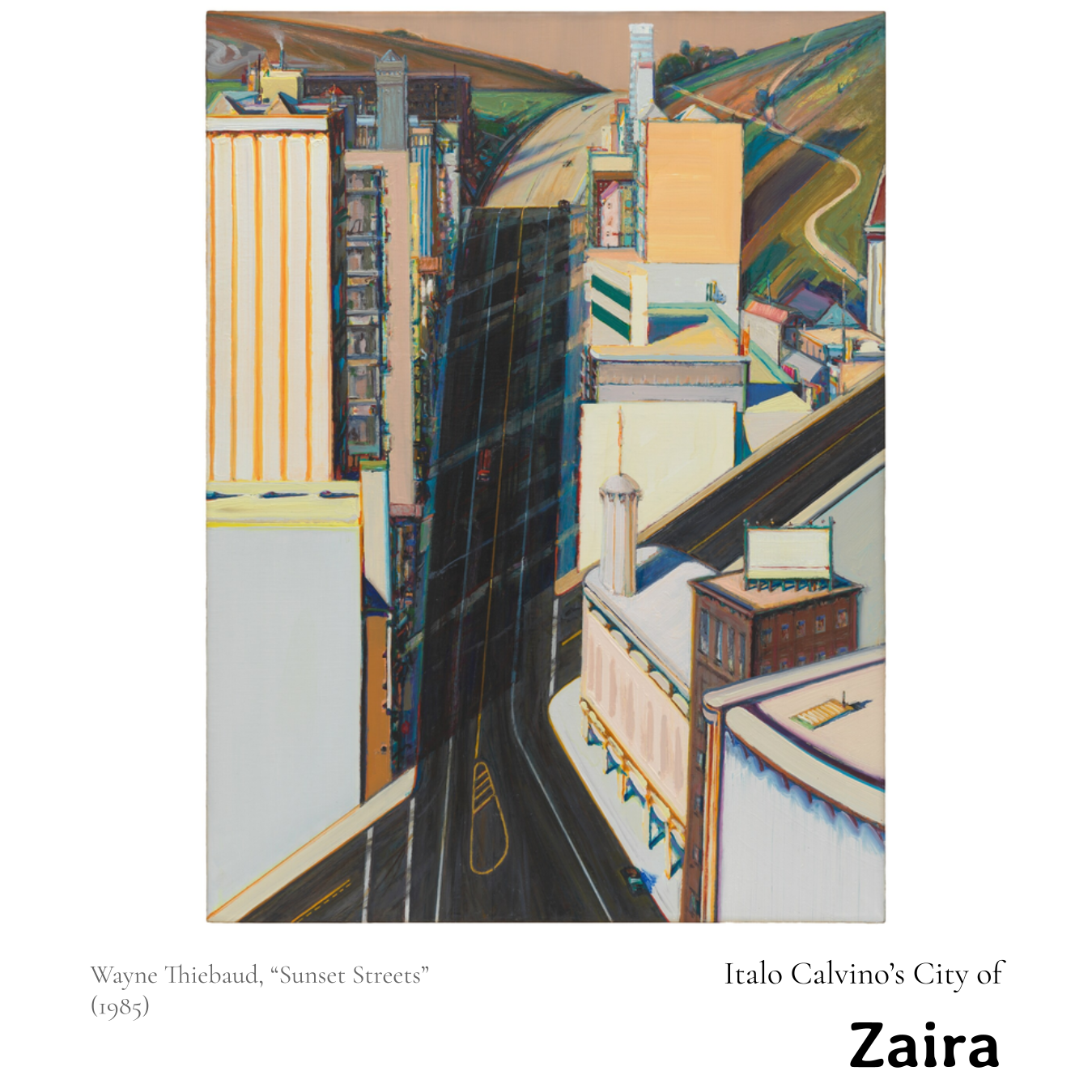
The Calvino city that best represents The Jacaranda’s theme for September (Echo) is Zaira. A city that refuses to articulate its own history through monuments or archives, but contains its past like the deep creases of a palm engraved silently into the height of its balustrades, the notches of its window grates, and the worn stone of its stairways. The inhabitants do not inhabit a vacuum of immediate experience; they walk through an accumulated spatial memory where every past gesture, unheeded conflict, and everyday routine remains physically inscribed into the masonry, compelling the present body to retrace paths already grooved by those who came before. In Zaira, the echo is entirely architectural. To navigate its steep inclines is to participate in an involuntary loop of return, brushing against the physical indentations of vanished lives that continue to structure and limit every new step taken through the city. Awareness in Zaira is not an intellectual recollection of the past, but an encounter with the stubborn inertia of the material world: the realization that the self is perpetually preceded by historical infrastructure, where every spoken intention merely reverberates against an ancient acoustic surface that dictates the cadence of its return. Featured alongside it is Wayne Thiebaud’s Sunset Streets (1985). Thiebaud abandons traditional vanishing-point depth, tilting the urban landscape into a sheer, vertical cliff of pastel high-rises and dramatic asphalt drops edged in glowing, high-voltage lines of orange, turquoise, and yellow. In this dizzying canvas, the streets do not offer an open escape; they rise like an impenetrable wall of accumulated infrastructure, mirroring Zaira’s dense, vertical containment of memory. The saturated, candy-colored palette and impossible perspective feel less like an inviting coastal avenue and more like a towering cross-section of urban sediment. A visual score of concrete and telephone wires that forces the viewer to confront the city as an inescapable labyrinth where motion is trapped inside an endless geometric ascent. Thiebaud’s sharp, hyper-structured perspective echoes Zaira’s cyclical logic. The luscious, heavy paint and radiant neon halations construct an eerie theater of urban stasis, where the solitary viewer is confronted with a landscape worn into rigid habit by millions of forgotten commutes. It is the steep, humming cadence of a city that preserves everything without uttering a single word, a sun-drenched, vertigo-inducing grid that reminds us that the past never truly recedes, it simply waits as the sheer face of the street we are doomed to climb again. #italocalvino #waynethiebaud #popart #invisiblecities #september