Eutropia
When he enters the territory of which Eutropia is the capital, the traveler sees not one city but many, of equal size and not unlike one another, scattered over a vast, rolling plateau. Eutropia is not one, but all these cities together; only one is inhabited at a time, the others are empty; and this process is carried out in rotation. Now I shall tell you how. On the day when Eutropia's inhabitants feel the grip of weariness and no one can bear any longer his job, his relatives, his house and his life, debts, the people he must greet or who greet him, then the whole citizenry decides to move to the next city, which is there waiting for them, empty and good as new; there each will take up a new job, a different wife, will see another landscape on opening his window, and will spend his time with different pastimes, friends, gossip. So their life is renewed from move to move, among cities whose exposure or declivity or streams or winds make each site somehow different from the others. Since their society is ordered without great distinctions of wealth or authority, the passage from one function to another takes place almost without jolts; variety is guaranteed by the multiple assignments, so that in the span of a lifetime a man rarely returns to a job that has already been his.
Thus the city repeats its life, identical, shifting up and down on its empty chessboard. The inhabitants repeat the same scenes, with the actors changed; they repeat the same speeches with variously combined accents; they open alternate mouths in identical yawns. Alone, among all the cities of the empire, Eutropia remains always the same. Mercury, god ofthe fickle, to whom the city is sacred, worked this ambiguous miracle.
Notes
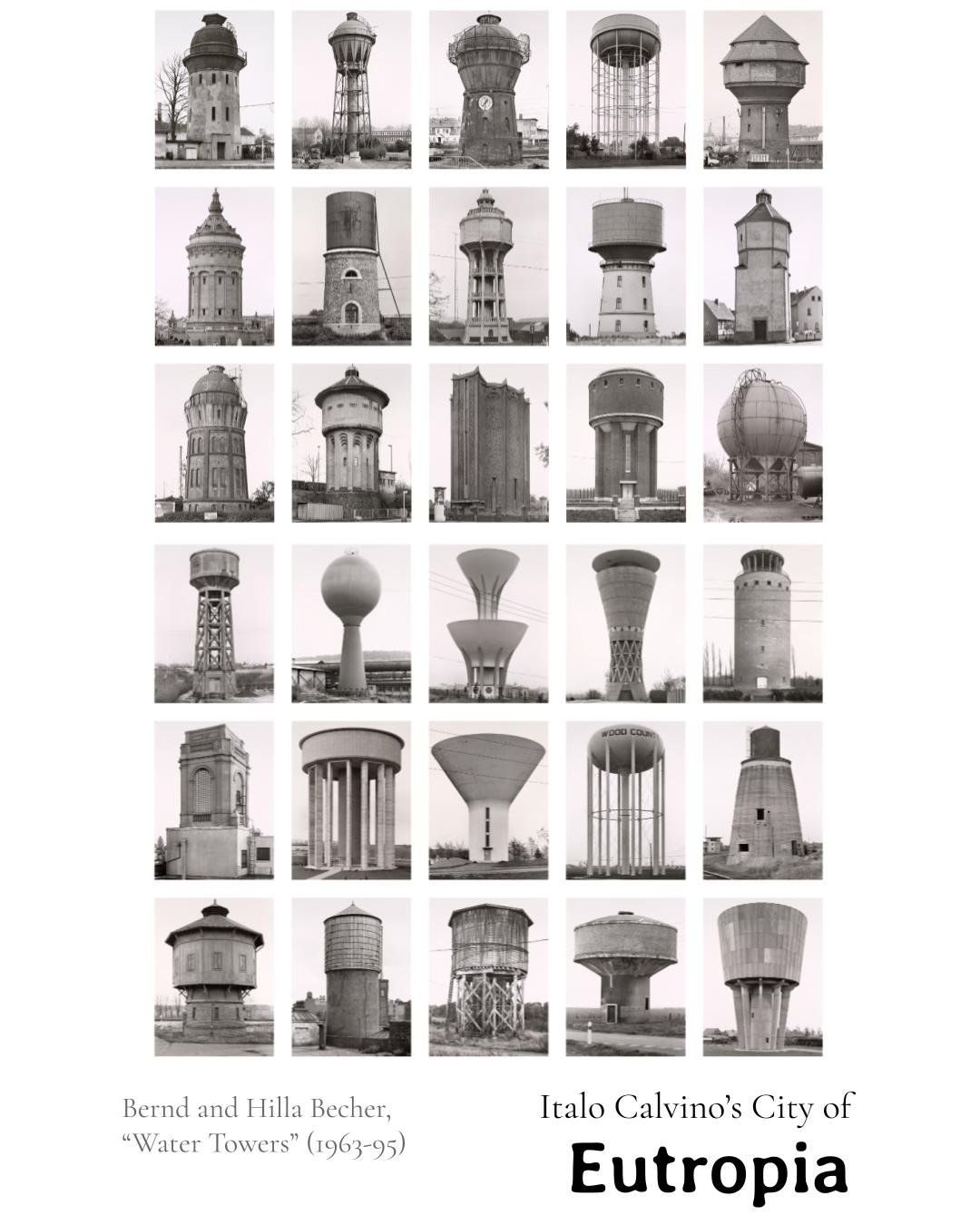
The Calvino city that best represents The Jacaranda’s theme for April (Rebirth) is Eutropia. A city of vast, identical expanses where life is not lived in a single line, but in a series of cycles. When the inhabitants feel the weight of their days, they do not repair their lives, they depart. Moving to the next empty shell on the plateau, they swap names, trades, and families, discarding the old self to inhabit the new. Rebirth in Eutropia is not a slow bloom, but a sudden, functional reset. Featured alongside it are the industrial typologies of Bernd and Hilla Becher. Their grids of Water Towers (1963-95) stand as silent, modular monuments to this cycle. Stark, geometric, and repetitive, the towers represent the infrastructure of a life that can be replicated. Just as a water tower is a vessel to be filled, emptied, and refilled, Eutropia treats the human experience as a series of interchangeable volumes. The Bechers’ objective photography echoes Eutropia’s mechanical ethos: rebirth is not a mystical transformation, but a structural necessity. It is the rhythmic pulse of a city that survives by constantly starting over, poised in the quiet, steel-grey space between who we were and who we are about to be. . . . #postmodernism #industrial #italocalvino #poetry #philosophy