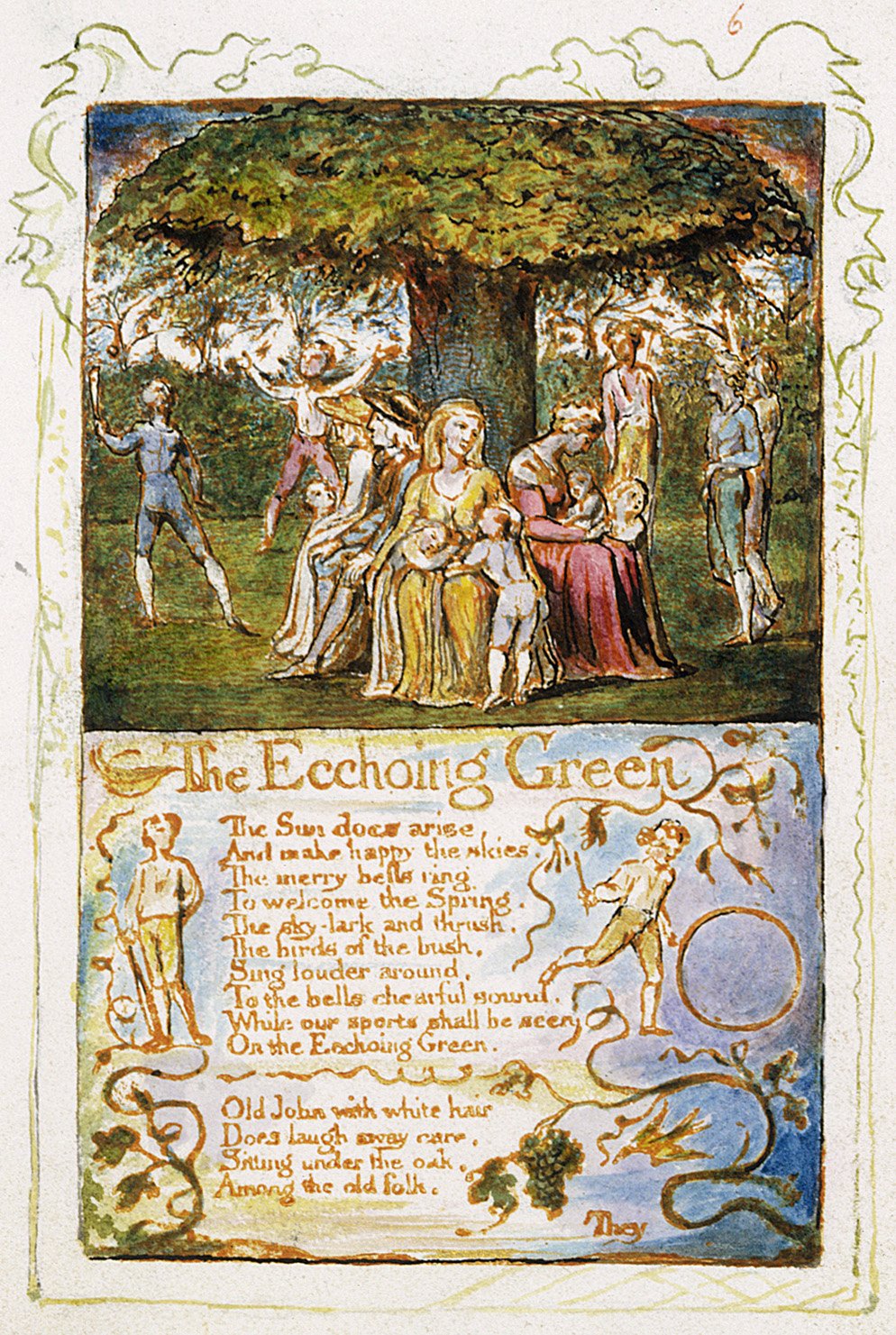
The Echoing Green
The Sun does arise,
And make happy the skies.
The merry bells ring
To welcome the Spring.
The sky-lark and thrush,
The birds of the bush,
Sing louder around,
To the bells' cheerful sound.
While our sports shall be seen
On the Echoing Green.
Old John with white hair
Does laugh away care,
Sitting under the oak,
Among the old folk,
They laugh at our play,
And soon they all say.
Such such were the joys.
When we all --girls and boys--
In our youth-time were seen,
On the Echoing Green.
Till the little ones weary
No more can be merry
The sun does descend,
And our sports have an end:
Round the laps of their mothers,
Many sisters and brothers,
Like birds in their nest,
Are ready for rest;
And sport no more seen,
On the darkening Green.
Notes
In "The Echoing Green," William Blake masterfully captures the cyclical nature of human existence, framing rebirth as the inevitable transition between generations. The "Echoing Green" is a space of perpetual renewal, where the vibrant energy of playing children is mirrored by the "Old John" and the elders who find a second life in witnessing the youth of others. As the sun sets and the "Echoing Green" becomes the "Darkening Green," the poem suggests that every ending is merely a prelude to a new beginning. A seasonal and spiritual return where the joys of the morning are stored within the memory to be reborn in the next cycle. Blake’s vision is uniquely unified; it is important to note that the featured artwork was created by Blake himself alongside his poems. Through his pioneering technique of relief etching, he synthesized text and image into a single "illuminated" entity, ensuring that the visual rhythm of the vines and figures reinforces the poem’s themes of growth and eternal recurrence. #poetry #williamblake #rebirth #spring #april