Valdrada
The ancients built Valdrada on the shores of a lake, with houses all verandas one above the other, and high streets whose railed parapets look out over the water. Thus the traveler, arriving, sees two cities: one erect above the lake, and the other reflected, upside down. Nothing exists or happens in the one Valdrada that the other Valdrada does not repeat, because the city was so constructed that its every point would be reflected in its mirror, and the Valdrada down in the water contains not only all the flutings and juttings of the facades that rise above the lake, but also the rooms' interiors with ceilings and floors, the perspective of the halls, the mirrors of the wardrobes.
Valdrada's inhabitants know that each of their actions is, at once, that action and its mirror-image, which possesses the special dignity of images, and this awareness prevents them from succumbing for a single moment to chance and forgetfulness. Even when lovers twist their naked bodies, skin against skin, seeking the position that will give one the most pleasure in the other, even when murderers plunge the knife into the black veins of the neck and more clotted blood pours out the more they press the blade that slips between the tendons, it is not so much their copulating or murdering that matters as the copulating or murdering of the images, limpid and cold in the mirror.
Notes
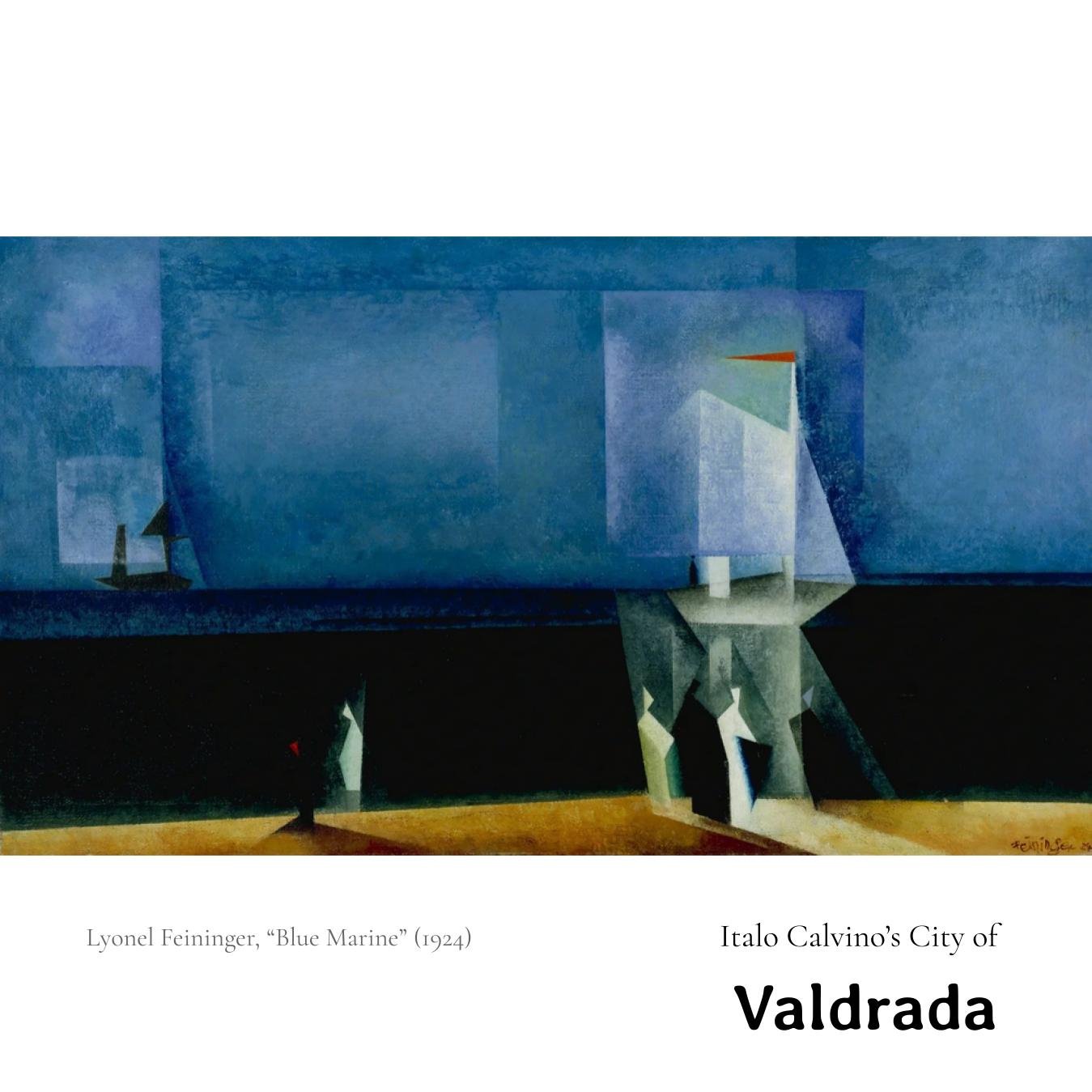
The Calvino city that best represents The Jacaranda’s theme for May (Mirror) is Valdrada. A city built on the shores of a lake, so precise in its symmetry that every movement has its twin. The inhabitants do not live a private life; they live a mirrored one, where every gesture of love or violence is simultaneously enacted in the water below. In Valdrada, self-recognition is unavoidable. To act is to watch oneself acting, a constant confrontation with the stranger in the glass. Awareness in Valdrada is not a moment of peace, but a realization of the split: the understanding that you are both the body and the image, forever locked in a mutual gaze. Featured alongside it is Lyonel Feininger’s Blue Marine (1924). Feininger uses translucent, overlapping planes to create a world where the horizon is a sharp, geometric fracture. In Blue Marine, the sea and sky do not just meet; they reflect one another through layers of crystalline blue, mimicking the "mirror-fidelity" of Valdrada. The waves and the sails feels less like nature and more like a series of shards. A visual "slice to the eyelid" that forces the viewer to see the world as a fragmented whole. Feininger’s cubist-expressionist lens echoes Valdrada’s unsettling logic: the reflection is not a passive copy, but a structural force. The deep, intersecting blues create a labyrinth of light where the "I" is swallowed by its own environment. It is the rhythmic pulse of a city that exists only through its double, a silvered, cold-cornered god that reminds us that to look into the mirror is to see the self as a beautifully constructed fiction. . . #Italocalvino #postmodernism #cities #cubism #expressionism