Zobeide
From there, after six days and seven nights, you arrive at Zobeide, the white city, well exposed to the moon, with streets wound about themselves as in a skein. They tell this tale of its foundation: men of various nations had an identical dream. They saw a woman running at night through an unknown city; she was seen from behind, with long hair, and she was naked. They dreamed of pursuing her. As they twisted and turned, each of them lost her. After the dream, they set out in search of that city; they never found it, but they found one another; they decided to build a city like the one in the dream. In laying out the streets, each followed the course of his pursuit; at the spot where they had lost the fugitive's trail, they arranged spaces and walls differently from the dream, so she would be unable to escape again.
This was the city of Zobeide, where they settled, waiting for that scene to be repeated one night. None of them, asleep or awake, ever saw the woman again. The city's streets were streets where they went to work every day, with no link any more to the dreamed chase. Which, for that matter, had long been forgotten.
New men arrived from other lands, having had a dream like theirs, and in the city of Zobeide, they recognized something from the streets of the dream, and they changed the positions of arcades and stairways to resemble more closely the path of the pursued woman and so, at the spot where she had vanished, there would remain no avenue of escape.
The first to arrive could not understand what drew these people to Zobeide, this ugly city, this trap.
Notes
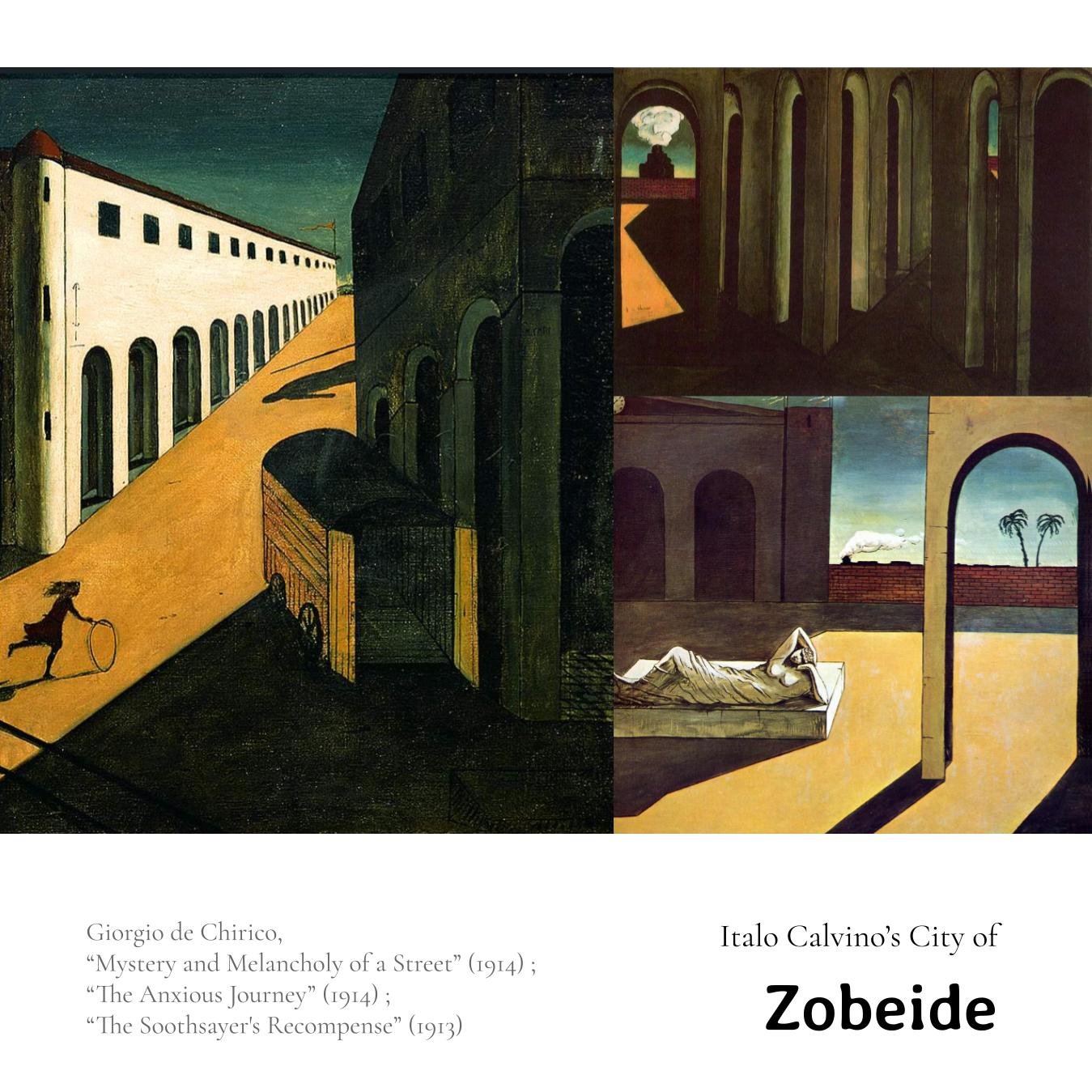
The Calvino city that best represents The Jacaranda’s theme for June (Desire) is Zobeide. A city built not from a blueprint, but from a collective failure founded by men who all shared the exact same dream of chasing a woman through an unknown city at night, only to lose her at a street corner. The inhabitants do not live in an organic settlement; they live in a geometric trap, where every alleyway and wall is a hardened monument to a lost pursuit. In Zobeide, desire is entirely structural. To wander its streets is to retrace a phantom line, a constant friction against a space designed to contain a presence that has already escaped. Awareness in Zobeide is not a moment of satisfaction, but a realization of the grid: the understanding that the city remains completely intact while the initial fire has vanished, leaving the self to wander through a permanent architecture of absence. Featured alongside it is Giorgio de Chirico’s Mystery and Melancholy of a Street*(1914), The Anxious Journey (1914), and The Soothsayer's Recompense*(1913). De Chirico uses deep, hauntingly long shadows and distorted classical arcades to create a world where space itself feels like a psychological maze. In these metaphysical canvases, the empty squares and silent brick walls do not just depict a city; they embody the anxious, claustrophobic loop of the chase, mimicking the rigid gridlock of Zobeide. The plunging perspectives and isolated silhouettes feel less like a real neighborhood and more like a series of stages. A visual architecture of anxiety that forces the viewer to see the landscape as an echo chamber of an unfulfilled hunger. De Chirico’s surrealist lens echoes Zobeide’s unsettling logic. The deep, intersecting shadows and hidden corners create a labyrinth of time where the "I" is swallowed by its own obsessive memory. It is the rhythmic, silent pulse of a city that exists only through its lack, a sun-drenched, cold-cornered god that reminds us that to build a trap for desire is to find oneself permanently locked inside the maze of the chase. #italocalvino #giorgiodechirico #surrealist #metaphysical #philosophy