Baucis
After a seven days' march through woodland, the traveler directed toward Baucis cannot see the city and yet he has arrived. The slender stilts that rise from the ground at a great distance from one another and are lost above the clouds support the city. You climb them with ladders. On the ground the inhabitants rarely show themselves: having already everything they need up there, they prefer not to come down. Nothing of the city touches the earth except those long flamingo legs on which it rests and, when the days are sunny, a pierced, angular shadow that falls on the foliage.
There are three hypotheses about the inhabitants of Baucis: that they hate the earth; that they respect it so much they avoid all contact; that they love it as it was before they existed and with spyglasses and telescopes aimed downward they never tire of examining it, leaf by leaf, stone by stone, ant by ant, contemplating with fascination their own absence.
Notes
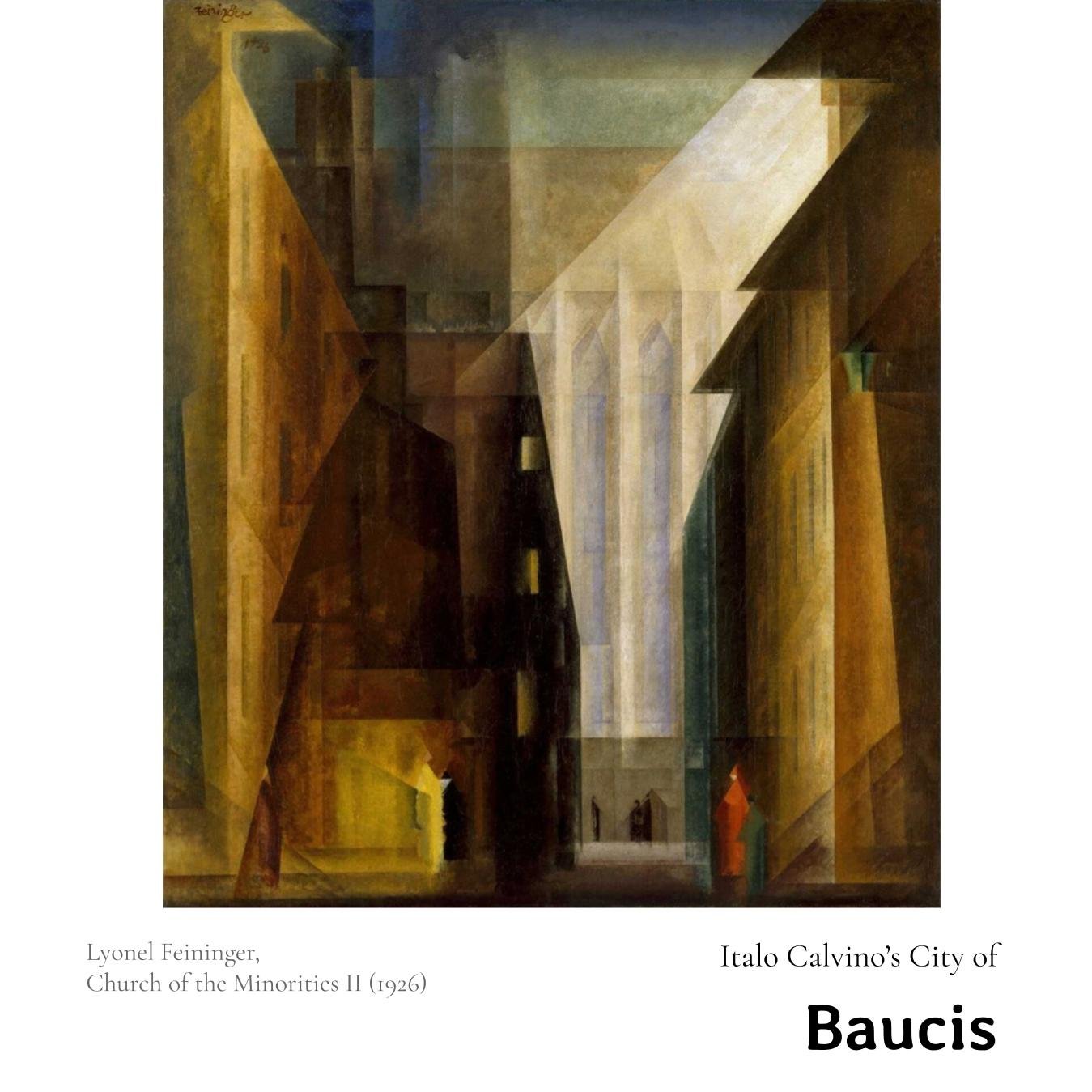
The Calvino city that best represents The Jacaranda’s theme for July (Lightness) is Baucis. A city built not upon the heavy foundations of the earth, but suspended entirely on spindly, delicate stilts that rise high above the clouds, where the inhabitants choose to live in absolute detachment from the ground. The inhabitants do not live in a dense, suffocating settlement; they live in a geometric web, where every platform and wireframe structure is a weightless monument to the art of staying unburdened. In Baucis, lightness is entirely structural. To wander its elevated pathways is to glide over reality from above, a peaceful, fluid friction against a world that is always slipping away beneath the mist. Awareness in Baucis is not a moment of heavy paralysis, but a realization of the ether: the understanding that the self can stop fighting its own structural void and learn to comfortably inhabit it, leaving the ego entirely unanchored to dance within the margins of a transient hour. Featured alongside it is Lyonel Feininger’s Church of the Minorities II (1926). Feininger uses overlapping, translucent planes of light and intersecting geometric rays to create a world where space itself feels like a crystal prism. In these Prisma-Cubist canvases, the towering architectural walls do not depict stone density; they embody the cool, airy release of psychic tension, mimicking the gravity-defying grid of Baucis. The soaring perspectives and dematerialized lines feel less like a real building and more like a constellation of energy. A visual architecture of release that forces the viewer to see the landscape as an echo chamber of a profound, weightless clarity. Feininger’s avant-garde lens echoes Baucis’s liberating logic. The sharp, luminous intersections and see-through horizons create a sanctuary of time where the "I" is swallowed by the pure joy of the passing spark. It is the rhythmic, silent pulse of a city that exists only through its absence from the ground, a sky-bound, sun-bleached haven that reminds us that to refuse to be weighed down by gravity is to find oneself permanently liberated within the architecture of the air. . #italocalvino #expressionist